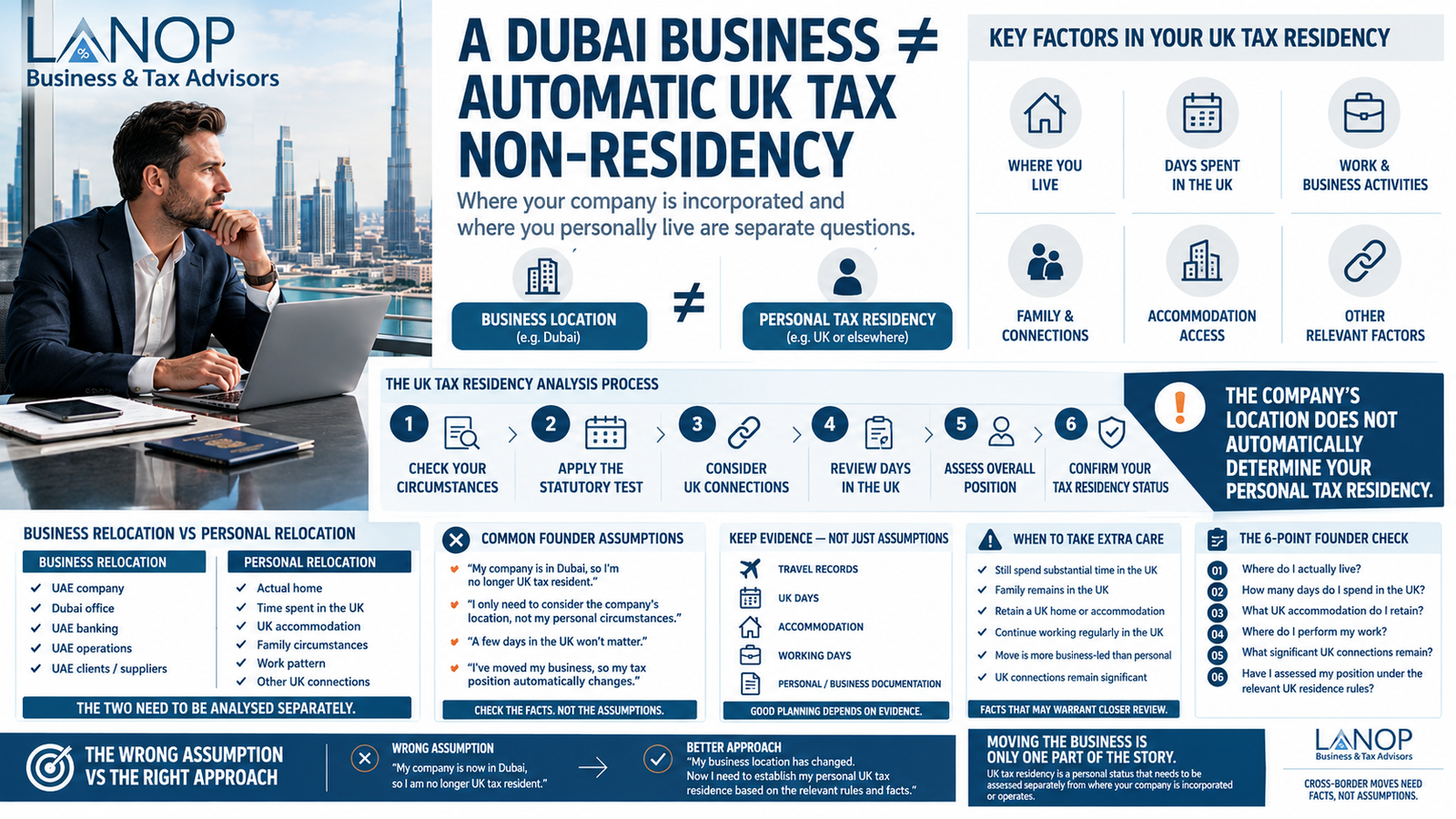

You’ve registered the company. You’ve got the visa. Here’s the truth nobody tells founders early enough: business setup in Dubai from the UK doesn’t automatically switch off your UK tax residence. Those are two separate questions, and HMRC treats them that way.
Three things need untangling. Where are you tax resident? Where is your company managed? And where does your income actually arise?
The starting point is the UK’s Statutory Residence Test, or SRT. Most founders know it through the “183-day rule” : stay under that number of days, and you’re free and clear. That’s not quite how it works, and believing it can get expensive.
Moving the Business Isn’t the Same as Moving You
Setting up a Dubai company is a business decision. Becoming a non-UK resident is a personal one. They don’t move together automatically, no matter how tidy that would be.
Think of it as three separate boxes. You, personally, have a tax residence. Your company has its own residence, based on where it’s actually managed. And your income sits in a third box, taxed according to where it’s generated. A founder can tick every box for “living in Dubai” and still land firmly inside a UK tax residence if the personal test isn’t satisfied.
So does incorporating in the UAE stop UK tax on its own? No. It changes where the company sits, not where you sit.
See also: Artificial Intelligence in Environmental Protection
How HMRC Actually Decides Where You’re a Resident?
The SRT works through a sequence of tests. First come the automatic overseas tests. Spend very few days in the UK, or work full-time abroad, and you may qualify as a non-resident straight away. Then there are automatic UK tests, which can make you resident even if you spend surprisingly little time here.
If neither set of automatic tests settles things, you move to the sufficient-ties test. This is where your UK connections start to matter, and where the 183-day assumption falls apart. The fewer days you spend in Britain, the more ties you’re allowed to have before you tip back into residence. But if several ties apply, even a modest number of days can keep you resident.
| UK Tie | Why It Matters |
| Family | A spouse or child in the UK can count as a tie |
| Accommodation | Available UK housing, even unused, can be relevant |
| Work | UK workdays feed directly into the analysis |
| 90-day history | Time spent in the UK in prior years still counts |
| Previous residence | Long UK residence history changes your threshold |
The Ties That Quietly Keep Founders Resident
If your spouse and kids stay in the family home while you set up in Dubai, that’s a tie. It adds weight, though it doesn’t decide the outcome alone.
Keeping the UK house does the same, even if you rent it out. That changes how the accommodation test looks at it, but the tie doesn’t disappear entirely.
Work is the one people underestimate most. A client call, a board meeting, a quick office visit these count as UK workdays if you’re not tracking them. And a longer UK residence history raises the bar for staying non-resident.
A UAE Visa Isn’t a UK Tax Answer
Getting an Emirates ID or a UAE residence visa proves where you can legally live and work. It says nothing about UK tax residence. Two entirely different systems, two entirely different tests.
The same goes for a UAE Tax Residency Certificate. It’s useful, sometimes essential, for treaty purposes but it doesn’t override the UK’s own residence analysis. You can genuinely be a tax resident in both countries at once, which is exactly why the UK-UAE double tax treaty exists.
What Happens to Your UK Ltd?
Keeping your existing UK company isn’t automatically wrong, and closing it isn’t automatically right. It depends on what the company does now, who runs it, and whether a Dubai entity should sit alongside it, above it, or replace it.
The bigger risk is running the Dubai company while you’re still physically working from the UK. If the real management and decision-making happens on British soil, HMRC can treat the company itself as a UK resident regardless of where it’s incorporated.
So How Many Days Can You Actually Spend Here?
There’s no universal safe number, and anyone who gives you one is guessing. It depends on your ties, your history, and whether those days count as visits or workdays.
The practical answer is boring but effective: track everything. Flights, calendars, meetings, accommodation keep records rather than relying on memory, because your tax position may hinge on a handful of specific dates.
Non-Resident Doesn’t Mean No UK Tax
Even once you’re clearly non-resident, the UK doesn’t disappear from your tax return entirely. Rental income and gains on UK property stay taxable, sometimes at rates that surprise people who assumed a clean break. Certain UK-source income and pensions can remain in scope too.
Filing obligations don’t vanish either. Many non-residents still need a UK Self Assessment return, especially in the year they leave, when split-year treatment often applies but only if specific conditions are met.
Five Mistakes We See Founders Make
Assuming the Dubai company ends UK residence. It doesn’t. Company residence and personal residence are decided by completely different rules.
Relying only on the 183-day rule. Day count matters, but it’s only one input. Ties can pull you back into residence even with a low day count.
Treating a UAE visa as the answer. Immigration status and tax residence are separate systems. One doesn’t confirm the other.
Keeping UK accommodation without thinking it through. An empty spare room still counts as a tie. Few founders realise that until it’s too late to plan around.
Not tracking UK workdays. A call, a board meeting, a quick site visit these add up fast, and memory is a poor substitute for records.
A Quick Checklist Before You Move
- Review your current UK residence position and count your recent UK days
- List every UK tie: family, property, work, previous residence
- Decide what happens to your UK Ltd keep it, restructure it, or close it
- Check whether split-year treatment might apply to your departure year
- Start keeping travel and work records from day one, not after a query lands
Frequently Asked Questions
Does moving my business to Dubai automatically make me a non-UK resident?
No. Your company’s location and your personal tax residence are assessed separately under the SRT. One doesn’t determine the other, no matter how the paperwork looks.
Is the 183-day rule enough to become a non-UK resident?
Not by itself. Day count is one part of the SRT, and your ties to the UK matter just as much. Someone with fewer ties can spend more days here than someone with several.
Does my UK home affect my tax residence?
It can. Keeping accommodation available in the UK, even unused, counts as a tie under the sufficient-ties test. Renting it out changes the picture, but it doesn’t remove the tie entirely.
Can I keep my UK Ltd after moving to Dubai?
Yes, but where it’s actually managed matters more than where it’s registered. Run it from the UK, and it can stay UK tax resident regardless of where it’s incorporated. That’s a separate question from your own residence.
Do I still pay UK tax after becoming non-resident?
Often, yes. UK rental income, property gains, and certain UK-source income can remain taxable even once you’re non-resident. Non-residence narrows your UK tax exposure; it doesn’t erase it entirely.
Conclusion
We’ve seen founders assume the Dubai company alone settled everything, only to discover a UK tax bill waiting when they least expected it. The pattern repeats: family staying behind, a UK house kept “just in case,” and workdays nobody counted.
Lanop Business & Tax Advisors works specifically with UK founders handling business setup in Dubai from UK soil assessing your personal residence position and structuring the UK and Dubai entities correctly from day one. The advice changes with the facts, which is exactly why generic guidance rarely holds up.
Moving your business to Dubai is a genuine opportunity. Just make sure your tax residence actually moves with it.